
Episodes
-
I started by naming a podcast, as you do. Some experts tell you not to overthink when naming a podcast. So instead, I underthought.
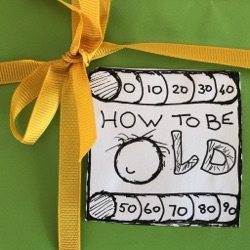
"Learning How To Be Old" is a terrifying title. It drives people away in droves, screaming and blocking their ears. So, bad name for a podcast! (You would rather be dead than old, true?) So why do I carry on? Mainly for fun: I find the whole creative process entrancing, and I just love coaxing my guests to speak their minds.
If you find the prospect of old age scary, you're not alone. In my defence, I want show old age as a chunk of your real life — not a slab of nothingness. Many good things follow, like relief and purpose and self-esteem and — so much more fun!
In regular episodes, amazing guests, young and old, teach me something about how to live. (Hence my foolish naming of this podcast.) "Bonus" episodes are just me, thinking out loud about some aspect of my creative life, my personal artist's way.
Podcast names you need to avoid in 2025 (Buzzsprout)How to choose a great show or podcast name (Spotify)A popular play about an unpopular topic (WriteIntoLife.com) -
Deciding to be happy? My podcast guest 81-year-old Dale Copeland does just that. She's an assemblage artist, theoretical mathematician, maker of books, webmaster since 1997, writer, community art curator, and Taekwon-Do Master.
According to Dale, happiness is not an accident, nothing to do with good luck. It’s a rational, purposeful choice. Good idea to listen to this episode, because you might be old one day like Dale and me.
This episode is packed with little gems, from elephant jokes to tips on self defence for little old ladies. Listen how she plays down some momentous achievement of hers, like, when her instructor says, “Dale, there isn’t a book about the history of Chang Hon Taekwon-Do. Why don’t you write one?" She replies, "Yes sir!” Or she tells you that her website exhibiting public art was apparently the first, or that she ran an international collage exchange for 20 years or that her grandmother wore a piece of pink flannel round her waist to keep out the cold.
Taranaki queen of art Dale Copeland becomes taekwondo mater at 80 (Stuff)Virtual Tart—Art from Taranaki, New ZealandTaranaki Taekwon-Do Ending Season 3 and deciding to be happy and proudYes, this is the last episode of the current season of Learning How To Be Old. I'm proud of this year's episodes. I'll be back! But it's good to have a break, do some other stuff, and make sure the next batch of episodes is well seasoned and well cooked. (I'm already excited.)
Meantime, thank you for listening. I know your time is precious. I hope you've been picking up some tips on how to be old. Your personal vision of old age tends to come true for you, did you know that? So remember Dale's story — 81 can be fun!
-
Missing episodes?
-
Introducing two remarkable women who are happily still working at 77. Liz Melchior's career has come full circle: she's back in the classroom, teaching primary school children after 20 years teaching adults. Helen Moulder continues to tour plays around New Zealand, including those featuring her much-loved comic character, Miss Cynthia Fortitude, the deluded opera singer. We chat, and I pick up some good tips on how they manage their stamina and work-life balance. Expect nothing, but be open to opportunities. Lots of joy and common sense in this episode!
Have you started thinking about retirement? That's an odd word, now that our work patterns are so different from the job-for-life model of the olden days. Those working at 77 are more visible these days. But sadly, in New Zealand the majority keep working out of necessity, because of the high cost of living. Liz and Helen feel lucky because they have opportunities to do work that they love, and work that can be tailored to their needs as they age. They don't take it for granted, either.
We're now into Season 3 of Learning How To Be Old. (Season 1 had a different name and may not be findable now.) If you click "Follow" when you're listening, you'll find out whenever a new episode is broadcast.
You may notice that the sound quality is lower than in other recent episodes. My bad! I was still using my first microphone, and learning on the job. But they are wonderful interviews, regardless.
Thanks for listening! I wouldn't be doing this otherwise.
More about working at 77 and beyondTime Sensitive podcast. Malcolm Gladwell: On finding freedom in abandoning expectationsAlice Walker: Expect nothingPew Research: The growth of the older workforce 2023 (In USA).Retirees work into 80s, 90s with ‘insufficient’ Super and snowballing living costs -
Are your parents ready for downsizing in later life? That's when it hits us. One day it could be our turn. My brain knows it's quite likely going to happen to me one day. That's something I find very hard to imagine and so I'm in denial for now.
All the more reason to learn about the process. So I asked two people to tell me about it, both of whom are masters of downsizing in later life.
Two movers with vast experienceFirst I met with Judy McCallum, co-owner of Taskmasters, a company of organisers who operate in the North Island of Aotearoa, in the Bay of Plenty, and in Wellington, Wairarapa, and Kapiti. The staff of Taskmasters are all over 50, and have all seen their parents downsizing — so they have a very personal understanding of what it means to move house in later life. It's highly emotional stuff!
Then I talked to Lindsay McCallum, who moved multiple times as a child and as a family man. He has worked out some highly efficient ways of managing moves, and has some great tips. The last time he moved, he was aged 90, and this time, he worked with Taskmasters to make it ultra-simple, in fact, almost painless.
Tips on downsizing: you'll need them one dayAs always, we’re kind of accidentally practising all our lives for transition into old age and very old age. Helping your parents is like a rehearsal for that future event. I'll stack these tips on downsizing in my old age away in the back of my brain for the day when I can't manage the stairs in my apartment.
Please enjoy the brilliant insights of my two guests, and a poem about my experience of moving over and over again when I was a child, one of six sisters.
LinksAn early version of the poem "Thou house"Taskmasters New Zealand (a company that helps you to downsize)Annalisa Barbeiri's advice to the children of downsizable parents -
This podcast episode is all about a lesson in falling safely, especially in old age. You heard that right. Not preventing falls — which is crucial, but there’s already plenty of information and training available for preventing falls.
No, this is about learning how to fall as safely as possible with minimal damage to our body and brain. Because sometimes everyone falls over. We trip, slip, tumble and lose our balance – especially in old age. And when you’re old, the consequences are usually more drastic than when you’re young and bouncy.
So I called on Simon Manns, a stage fight director, to start training me to fall safely. Simon directs fight scenes for stage productions, which means he trains opera singers, dancers, circus performers and actors to fight realistically and safely on stage. As he says, they have to do their stage fight — and most likely fall over — five times a week and twice on Sunday, without hurting themselves.
Listen as Simon talks about falling safely and start training me, step by step, starting on all fours. He explains and directs. I say "Whoosh!" and "Oops!"
A pilot course in falling safely in Wellington, New ZealandWould you like to train your body to fall as safely as possible? In June 2025, Simon will run a pilot 6-session course on falling safely — in a room with crash mats, in Wellington, New Zealand. Numbers are limited (for safety, of course!) so if you are interested, please contact me or Simon by email:
rachel <at> writing dot co dot nz or simon.swordplay <at> gmail.com
ROMEO & JULIET | Fight & Combat with Simon Manns (Royal New Zealand Ballet) Staying safe from trips and falls (ACC)I wrote this two years ago: I need to learn to fall like a child. -
Mindful habits help you to stay calm. Bring you back to reality when you feel confused. Fantastic now, crucial in old age. Listen if you might be old one day!
Welcome back to Learning How To Be Old, with me, Rachel McAlpine.
I’m 85, and with hindsight comes this insight. All our lives we’re accumulating habits that are going to have an impact on our future old age. Mindful habits will be exceptionally useful: the tiny habit of taking a moment to be mindful. They’ll help you every day. Especially if you’re always searching for your phone or compulsively checking things or getting anxious.
Mindful habits are useful for CEOs and old peopleToday my guest is Kerene Strochnetter, a workplace mindfulness consultant based in Wellington. She works with leaders and leadership teams, "helping them ditch the corporate mask and lead with heart (without losing their edge)." And you know what? What’s good for the CEO (mindful habits) is also good for you and me, at any age — even more so in old age. And even CEOs will be old one day, if they’re lucky.
In this episode you’ll get the gist of mindfulness not as an airy-fairy theory but as a practice, a daily routine, a set of simple habits of your own choice. Things you can do in half a minute, any time, on the spot. (Expect some odd anecdotes and noises in the mix. Some are intentional.)
Crazy Busy: If busy is the new stupid, then mindful is the new smart, by Kerene StrochnetterThe 5-Minute Meditator: How to relax your body and mind whenever you want to, by Eric Harrison (free PDF)The way of the walker: walking mindfully, A blog post on WriteIntoLife.comForgot why you went downstairs? Try audible mindfulness: talking to yourself. A blog post on WriteIntoLife.comMeditation: the method is the medium. WriteIntoLife.com -
We can learn a lot about how to grow old from aging the Māori way. Welcome back to this podcast, Learning How To Be Old. Listen if you might be old one day ... even if you don’t believe that will ever happen.
Today’s guest — and a fount of precious knowledge — is Grace Hoete. She is Senior Arts Advisor for the Wellington City Council and the manager of Toi Poneke. But I got to know Grace as an actor. In my last play, The Secret Lives of Extremely Old People, she played a 93-year-old Māori writer called Puti. Like all 5 characters in the play, Puti is an imaginary character but she speaks a true story based on the words and stories of people who were children in the 1930s. And that makes them different from you and me.
Grace has known very old people who share many of Puti's life experiences, and she tells us a great deal about aging the Māori way. It’s fitting that she should share this knowledge in a podcast, with her glorious voice, and not in writing — because the Māori way of passing on knowledge is also oral.
The podcast ends with a very old song in te reo, He Puti Puti Pai. The words were written in 1926 by Sir Apirana Ngati, and the Turakina Māori Girls College Choir recorded the song in 1978, as far as I can tell. Thanks to Viking Sevenseas for permission to share it in this episode about aging the Māori way.
Two new productions of my play about the lives and thoughts of nonagenariansAuckland: from 2–6 April 2025 you can see The Secret Lives of Extremely Old People at the Dolphin Theatre in Onehunga. I’ll be there on the last afternoon for a Q&A session. Come along, do!
Timaru: from 9–16 May the South Canterbury Drama League is showing the play, and I’ll be there on the 14th and 15th. Maybe we’ll meet: please introduce yourself!
Kaumātua and their role. Te Ara, The Encyclopaedia of New ZealandTheatre Against Ageism and The Secret Lives of Extremely Old People (first production) Dolphin Theatre, Onehunga: The Secret Lives of Extremely Old People, 2–6 April 2025 South Canterbury Drama League, Timaru -
Pinky Agnew, a much-loved New Zealand comedian, entertainer, and funeral celebrant, talks with Rachel McAlpine (me) about managing friendships, especially in mid-life and old age. Midlife is a good time to consider your friendships and what lies ahead. Is fear of loneliness a factor in your private FOGO (Fear Of Getting Old)?
"Managing friendships" is not just about avoiding loneliness, a known killer of old people — it includes backing away from friends who are no longer right for you, being friendly to strangers, maintaining good friendships when circumstances change, accepting the loss of some friends, and being open to unexpected friendships.
Pinky has good tips on making new friends, dissolving friendships, how not to be a grumpy old bugger, and how to have 7 conversations a day. (She says that talking to a dog counts as a conversation, even if the dog does not talk back.)
I finish with a poem: "How to make friends when you're old."
Plenty to learn here about managing friendships, including from our best teachers: little children.
How to make friends as a middle aged man, even if the idea makes you feel weird Ross McCammon Time Magazine. 2018Annoying your friends An instant poem by me that I still find funny Cultivate women friends: a tiny tip for a happy healthy old age Simple as. Reposted from Margo's blog, date unknown -
There's no end to learning how to be old. More podcast episodes are coming soon. Very soon. In this trailer I'll tantalise you with a brief descriptions of my fabulous guests, all with precious, surprising, original insights into — guess what? Learning how to be old, of course. Even when you're very far from old.
I'm Rachel McAlpine, 85, and my guests are all somewhere between 45 and 91. There's a Tae Quon Do master/theoretical mathematician, a mindfulness coach, a celebrity-celebrant, a stage fight director, two actors, a teacher and a GP. What they talk about will entertain you and may surprise you. They'll certainly give you some hints about managing various problems around transitioning from adulthood to old age.
You'll also get some delightful insights from the man, woman, and child "in the street." Random pedestrians who very kindly answered my unsolicited questions.
Listen if you might be old one day. And listen if you're pretty sure you'll never be old, because you don't want to be. Come on. It'll be fun.
-
Welcome back to my podcast, Learning How to Be Old, and brace yourself for a hard look at the face of old age. When I was only 74 and I still had a bad case of ageism, I didn't like the look of old people. Now I look in the mirror and I see an old woman's face — and strange to say, I don't particularly care.
Dr Susanna Kent and I recorded this episode on my 85th birthday and we had a lot of fun, which I'm keen to share with you.
I demanded that Susanna explain why I've got dead-gorse-bush hair, non-existent eyebrows, and so many scars and wrinkles. I questioned random pedestrians: as you'll hear, most said they don't look at the face of a new acquaintance but into their eyes — or in one case, at their clothes! They look to see whether a person is approachable. They look for the essence, the spirit of a person. Which has nothing to do with wrinkles. And this episode ends with two poems I've written about makeup. One, "Making Faces", I wrote in my 30s. The second, "Beauty Tips For Older Ladies", I wrote in my 70s.
How attitudes change as time passes! And how differently various people see the face of old age.
Manuka Health Care Centre Aging Beauty — instant poem, WriteIntoLife.com
