
Episodi
-
1917 Tsarist Bonds
We know we promised to talk about Venezuela. But we got distracted by a filing in the district courts in DC. A claim for payment on Tsarist bonds from 1917, being made in 2026. How could we pass that up? We also confess to being intrigued that the lawyers for Russia have asked that the judge in DC — Judge Friedrich — give Rule 11 sanctions against the plaintiffs. There are clear potential barriers to this claim on the merits but asking for Rule 11 sanctions on this basis seems a bit rich. Plus, we love the resuscitation of old Tsarist or Imperial bonds.
Producer: Leanna Doty -
The Most Amazing Revolution
In spring 1917, the United States government lent money to the new Provisional Government in Russia, which had promised both domestic reform and to maintain the fight against Germany. Within a few short months, the Bolsheviks took over and repudiated all prior international debt. Still unpaid, the loans have now been in default nearly 150 times longer than they were current. We have talked about these loans before, but not about the repeated attempts (in the 1930s and 1990s) to reach a settlement. Some of the loan proceeds went to efforts to keep the Bolsheviks from power? Did the succeeding governments have to repay those debts?
Producer: Leanna Doty -
Episodi mancanti?
-
Something Black in the Lentils:
We are back with our favorite type of podcast — speculation about legal implications built around facts that are constructed entirely from rumor and innuendo. Weird stuff is going on with the Senegalese yield curve. And we wonder whether the weirdness might relate to Senegal’s desire to avoid triggering margin calls on its TRS contracts (which we'd really like to see). If there is some jiggery pokery going on - perhaps with respect to auctions of the three-year maturity - is that bad faith? Possibly, maybe, kinda sorta. We aren't English lawyers. We're barely even lawyers. But maybe there is something strange afoot. Surely it will all soon be disclosed, especially if Senegal defaults and all these contracts go . . . well . . .
Producer: Leanna Doty -
Foreign Civil War Entanglements
Over the years, the U.S. has supported the losing side in numerous foreign civil wars. It has emerged from these entanglements as both a debtor and a creditor. In each case, the U.S. government's formal position has been clear: the post-civil war government succeeds to the rights and obligations of the prior government. That is, the winning side must pay debts incurred by the prior government, and it may enforce rights that accrued to that government. The U.S. has consistently taken this position even when the rights and obligations at issue relate to its attempt to keep the winning side from attaining power (e.g., debts accrued in the context of arms sales to the U.S.-supported side). But pragmatically, the U.S. government's position has been more fluid, ranging from benign neglect (i.e., simply not asserting a claim to payment) to finding technical legal arguments to justify writing off a debt (e.g., deeming the debt uncollectible).
Producer: Leanna Doty -
If Only YPF’s Bylaws Had Been Governed by Texas Law
And… poof! The sound of a $16 billion judgment going up in smoke. We talk about the Second Circuit’s decision in the YPF case, which we read largely as a way to make an excessively large judgment disappear without ruling on any difficult (and recurring) issues of US law. YPF’s shareholders got screwed, but then again their rights were governed by Argentine law. Even in foreign courts, it is hard to win when the sovereign gets to set the rules. We also talk about those fun-lovin’ Texas legislators. Pardner, everything’s bigger in Texas. Except the pre-judgment interest rate. That there is just a whole lot smaller. Has been for 30 some years.
Producer: Leanna Doty -
The $500 Million American “Financial Aid” to China
In 1942, the Americans provided $500 million in financial aid to Chiang Kai-shek’s Nationalist government in China. Described as a “financial counterpart” to Lend-Lease aid, the credit — intended to help stabilize the Chinese economy and support its war effort — did not provide for principal repayment, interest payments, or state a maturity. The apparent intent was to negotiate terms in a post-war settlement of accounts, when the parties could agree on the “benefits to be rendered the United States in return” for the credit. That agreement never happened and, as best we can tell, the status of the credit remains unclear. (Was it a loan? A conditional grant? If the latter, were the conditions fulfilled?) The US doesn’t seem to have ever asserted a right to collect, but we also haven’t seen anything formally relinquishing the potential claim or formally acknowledging the credit as a grant.
Producer: Leanna Doty -
Ethiopia and Senegal: Debt Shenanigans?
A set of recent articles in the FT by sovereign debt guru Joseph Cotterill suggest to us (reading between the lines) debt shenanigans in both Ethiopia and Senegal. We can’t figure out exactly what is going on in these two cases, but there is enough there for us to engage in wild speculation. In Ethiopia, the bondholders seem to be irate that some big player (aka China) is interfering with their deal and they are threatening to use. In Senegal, someone (aka BOAD?) is engaged in a moral hazard play by buying up gobs of local Senegalese debt; this, at a time when the international market has shut out Senegal thanks to disclosure shenanigans.
Producer: Leanna Doty -
Can We Say Anything Meaningful About a Venezuelan Debt Restructuring?
Venezuela must restructure its debt if it, and its new "friends" in Washington DC, want the economy humming again. But how? The debt stock is enormous and the range of claims so vast that normal techniques are unlikely to work. And typically, before anything could happen, the IMF would need to go in and assess the actual situation on the ground. All this takes time. But we imagine that the folks in Washington DC want to declare their adventure a success, and soon. Is that impulse consistent with an orderly, comprehensive debt restructuring? For that matter, what would a restructuring look like if we also assume that Washington wants to line its own pockets with Venezuelan oil revenues, and perhaps to give preferential treatment to oil major creditors (to entice them back into Venezuela)? We don’t have answers — but we suspect that those folks in DC don’t either.
Producer: Leanna Doty -
Are CACs Unilateral Modification Clauses?
We have always understood the collective action clause (CAC) in a sovereign bond to allow the bond issuer to propose a modification to the bond, which will bind everyone if approved by the requisite proportion of holders. Typically the sovereign is proposing to restructure its debt. This is more or less what bonds governed by NY law say, but bonds governed by English law appear to allow bondholders to gang together to modify the bond without the issuer's consent. Can that be right? We don't really think so, but we don't see anything in the text of the standard CAC in English law bonds that requires issuer consent. Imagine a Euro area issuer is nearing crisis and holders of its local law debt decide to switch their bonds to, say, English law. Can they do this unilaterally? Maybe so.
Producer: Leanna Doty -
Will the Flip Clause Enter the Canon?
Contract innovation is rare in sovereign debt markets, so we are interested whenever someone adds a new clause to the existing set of canonical forms. A number of innovations have appeared in 2025, one of which is the "flip clause." The clause allows investors to opt out of the governing law and enforcement jurisdiction initially chosen in the debt instrument. We have some questions about the clause and doubt that in its current form it will gain widespread acceptance. Right now, it seems more symbol than substance — a way to metaphorically flip off the New York legislature.
Producer: Leanna Doty -
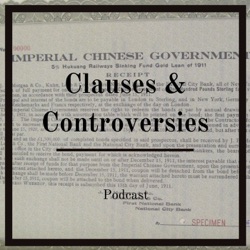
Imperial (Defaulted) Chinese Bonds (Again)
Yes, one of us might have sworn up and down that we would never do another episode about defaulted Imperial Chinese bonds. But a brand new case out of the DC federal courts has changed our minds. The case got the back of the hand from the district judge, but the arguments being made were not as weak as a quick glance at the opinion might suggest. Dare we hope for the entertainment value provided by an amicus brief filed by the Trump administration in support of the plaintiffs?
Producer: Leanna Doty -
Total Return Swaps
There have been reports in the financial press about the use of Total Return Swaps to provide credit to governments (e.g., Angola), often in situations where the government can't otherwise borrow on capital markets. As best we understand them (i.e., badly) these are derivatives backed by sovereign bonds and sometimes cash as collateral. The collateral reduces borrowing costs and the debt stays off books, since the obligation to pay the bonds is contingent (since the bonds are only collateral). We increasingly hear scuttlebutt suggesting these deals are commonplace, and some of our investor friends complain that TRSs effectively subordinate existing creditors. We don't understand TRSs well, and we have questions. Isn't this just garden variety debt dilution? Does it violate the negative pledge clause?
Producer: Leanna Doty -
Cambodia’s “Dirty Debts” to the US — Redux
In the 1970s, the US allowed Cambodia to finance the importation of rice and other agricultural commodities. The debt remains unpaid. One version of this story is that successor Cambodian governments have refused to pay these “dirty” debts. In this telling, the US used the loans to prop up a friendly but illegitimate Cambodian regime. Although the US shipped food, loan proceeds mostly financed the Cambodian military, which the US used as a proxy in the fight against the North Vietnamese and Khmer Rouge. Meanwhile, the US was bombing the Cambodian countryside, destroying domestic food production and contributing to a humanitarian crisis. To make matters worse, it turns out most of the food was sent to countries other than Cambodia. To some observers, the US bears a significant share of responsibility for the Khmer Rouge’s ultimate rise to power. Decades later, after indescribable suffering (caused at least in part by US interference) the US wants money back. The contours of this story are largely true, but the real story of the PL-480 “Food for Peace” program is more complicated. Today’s episode is about what we have found so far and the questions that still remain open.
https://papers.ssrn.com/sol3/papers.cfm?abstract_id=5561161
Producer: Leanna Doty -
What if POTUS wanted an OBBD?
Let us say, purely hypothetically, that there is a point at which some combination of the spending excesses of the One Big Beautiful Bill, the government shutdown, a rejection by the Supreme Court of tariff mania, and more, result in a shortfall of revenues for the current administration. And let us also say that POTUS goes to his brains trust to ask how best to do an OBBD/R (One Big Beautiful Default/Restructuring). What path might the brains trust take? And what about the option of taxing the treasury holdings of foreign governments, which the administration has already signaled its interest in?
Producer: Leanna Doty -
The Invasion Tax
The lawsuit over Ukraine's $3 billion bond debt to Russia seems to be on hold (maybe forever) in the English courts. And maybe there is no way for the Russian government to force repayment. Still, the debt is a minor cloud hanging (along with many bigger ones) over Ukraine. It would be nice if there was a way to make it go away permanently. Might there be? We talk about a common provision in a sovereign bond's Taxation section — we aren't sure how common, but it certainly isn't unique to Ukraine — that lets the issuer tax investors who have a connection to it other than simply holding its bonds. As written, this provision would allow Ukraine to impose a 100% tax on bond payments to Russia. This may not be what the drafters had in mind, and it opens the door to some unsavory tax shenanigans, but an Invasion Tax doesn't seem too objectionable.
Also: "Whatever it takes" means "whatever it takes!" Except when it means something else.
Producer: Leanna Doty -
Argentina Again
The Trump administration says it will do “whatever it takes” to rescue the Argentine peso and bond yields, saving buddy Javier Milei from electoral disaster. We do not think the U.S. Treasury can simply dole out money to Milei. If the administration does not want to go to Congress for permission (it generally does not), and if the Mexican bailouts of 1982 and 1995 are indicators, the U.S. Treasury will ask the Argentines to provide collateral of some sort. (The Falklands, maybe?) If so, holders of Argentine sovereign bonds might wonder whether they are entitled to some collateral too. Sovereign bonds have negative pledge clauses, which generally prevent the borrower from creating new secured debt without securing bondholders on equivalent terms. So, we looked at some of the negative pledge clauses in Argentine bonds. They are weird, but don't seem very protective. These are beautiful clauses, folks, BEAUTIFUL. Looks like the U.S. gets collateral, bondholders don't. Total disaster for them!
Producer: Leanna Doty -
Ukraine's Expansive "Fiscal Laws" Clause
International sovereign bonds, and particularly those issued under English law, often include a clause providing that payments are subject to the applicable "fiscal and other laws." Usually, the clause makes clear this refers to fiscal laws in the “place of payment” (e.g., Luxembourg). Separately, international bonds also provide that, if the issuer imposes any taxes on bond payments, it must "gross up" payments to foreign investors, so the tax does not reduce their payments. Together, the two clauses usually immunize foreign investors from taxes imposed by the issuer but leave room for taxes imposed by the place of payment. Ukraine's bonds are different. They seem to leave room for Ukraine to impose its own "fiscal" law on payments. Arguably, they leave investors subject even to local laws that aren't fiscal in nature. Might this be a source of leverage for the country in its negotiations with GDP warrant holders, who have so far refused to make concessions in restructuring talks?
Producer: Leanna Doty -
The Greek GDP Warrant Drama
Greece’s debt situation has improved remarkably, from default status in 2012 to investment grade in 2025. A few weeks ago though, Bloomberg reported on a brewing drama with the GDP warrants that were offered to investors in the brutal 2012 restructuring. Apparently, Greece has elected to exercise its right to call the warrants, and holders are yelling bloody murder at the low price at which Greece says it is entitled to buy. Every side has lawyered up and claims the other side is acting unreasonably. We speculate wildly on what might actually be going on and what is likely to happen.
Producer: Leanna Doty -
Some Questions, Now That it's About 3 Years Since Russia’s Default
It has now been around 3 years since Russia’s invasion of Ukraine, which prompted EU and US sanctions and a default on Russia’s external bonds. The prescription clause in these bonds says that Russia’s obligations become void unless investors make claims within three years of the date payment is due. What does it mean to “make” a “claim”? Filing a lawsuit would do the trick. What about an email requesting payment? An automated message, which the depository sends out every payment date? Should bondholders have sought an agreement tolling the prescription period? Since they didn't, does Russia now have what amounts to an option to pay past due amounts? And what about interest on unpaid amounts? Does Russia owe interest on payments that were impossible to make due to sanctions?
Producer: Leanna Doty -
Sovereign Debt Odd & Ends
An odds and ends podcast about unrelated sovereign debt topics. First up, Venezuela. Most investors have been sitting around waiting for an eventual restructuring and lifting of US sanctions. But a handful of funds sued early, got judgments, and have spent years trying unsuccessfully to collect. If they had succeeded, they would have recovered much more than similarly-situated creditors who waited around for a restructuring deal. But they failed and, in a bizarre twist, have asked the court to vacate their judgments, effectively returning them to the creditor queue. We cry foul. Next up, another fiscally-irresponsible and increasingly author ... well, it's the United States. We discuss the crazy (and terrifying) idea that the US might unilaterally extend the maturities of government debt.
Producer: Leanna Doty - Mostra di più
